Post 1 of the BLOBS series — the field theory, the vacuum, and the object itself.
Literature grounding (added after a 132-source review). The three-field system
below is not ours: it was introduced by Schenk, Or-Guil, Bode & Purwins
(Phys. Rev. Lett.78:3781, 1997) to model planar gas discharges, and
"blobs" are that field's dissipative solitons (review: Purwins, Bödeker &
Amiranashvili, Adv. Phys.59:485, 2010). Much of our phase-1 ladder
reproduces known results — spot existence, the drift bifurcation and its √-law
(Or-Guil et al. PRE57:6432; Krischer & Mikhailov PRL73:3165), tail-quantized soliton molecules (Bode et al. Physica D161:45; measured bond forces: Bödeker et al. New J. Phys.6:62) —
and we mark those sections accordingly. What appears new here: the pair-only
translation zone used as a transport selector, the nonreciprocal heterodimer rotor
design (rotating bound states themselves were found by Moskalenko, Liehr &
Purwins, EPL63:361 / EPJ B37:199), the relay-tug cargo
machine, the self-written-landscape design laws, and the algebraic pre-filter for
equation-space search. Full review: probes/blobs/litreview/REVIEW.md.
The idea. Instead of simulating creatures or particles directly,
we write down three interacting fields — think of three coupled "chemical
concentrations" filling space — chosen so that the field equations themselves hold stable,
particle-like excitations. Those excitations ("blobs") turn out to move, bind into
molecules, come in species, and can be assembled into working machines. The program
climbed that ladder one certified rung at a time:
existence → motility → binding → flavors → composite dynamics → a machine.
The fields and the equations
The world is a periodic 2-D square. Three scalar fields live on it:
field
role
timescale
range
intuition
u
activator
fast (1)
short (Du=1)
the "substance" of a blob; self-amplifying (cubic), wants to run away
v
slow inhibitor
slow (τ)
short-to-mid (Dv)
local memory / drag; where u has been, v builds up and pushes back
w
fast long-range inhibitor
very fast (θ=0.7)
long (Dw=20)
a wide "exclusion halo" broadcast around any activity; stops spreading and keeps blobs apart
∂u/∂t = Du∇²u + λu − u³ − k₃v − k₄w + k₁ (activator: cubic self-drive, inhibited by v and w, biased by k₁)
∂v/∂t = (u − v)/τ + Dv∇²v (v relaxes toward u with time constant τ)
∂w/∂t = (u − w)/θ + Dw∇²w (w relaxes toward u fast, but spreads far)
This is the three-component reaction–diffusion system of the
Purwins / Schenk gas-discharge class — a laboratory system (planar gas discharges)
in which all of the phenomena below were first seen experimentally. Baseline parameters
(the "M0 point"): λ=2, k₁=−0.7, k₃=1, k₄=1.5, τ=3, θ=0.7, Du=Dv=1,
Dw=20.
Baseline parameters (the M0 point)
λ
k₁
k₃
k₄
τ
θ
Du
Dv
Dw
grid
2.0
−0.7
1.0
1.5
3.0
0.7
1.0
1.0
20
L=96, dx=0.5–1, dt≤0.02
Every later post varies a handful of these and says which; the full
measured windows live in the series index dial table.
What is a blob?
The uniform "vacuum" state u=v=w=u₀ (the most negative root of
−u³+(λ−k₃−k₄)u+k₁=0, u₀≈−0.70) is stable: small pokes die out. But a big enough local
poke flips a patch of u onto the upper branch of the cubic, and the patch
then self-stabilizes: the long-range w halo it broadcasts prevents it
from growing or splitting, while the activator core prevents it from dying. The result is
a dissipative soliton — a self-maintaining, fixed-size spot of "on" field in an
"off" world. That is a blob. Its identity is measured (connected components + tracking),
never stored: delete the fields and the blob is gone; move the fields and the blob moved.
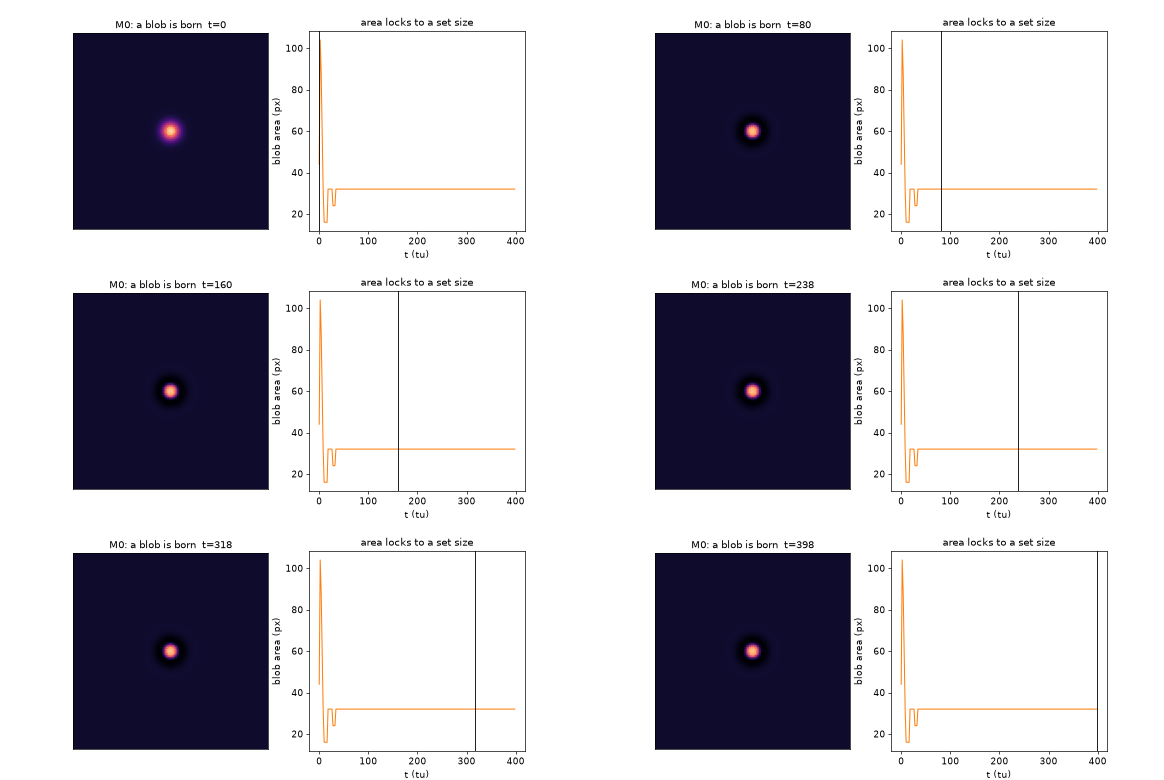
M0 — a blob is born. A Gaussian poke overshoots, sheds mass, and
locks to its preferred size (~26 px area at the M0 point), then persists indefinitely
(certified 10,000 tu, noise-robust). The area trace shows the size lock. Neighboring
parameter worlds fail in two directions: k₁=−0.9 → the poke dies; k₁=−0.5 or k₄=2.5 →
the poke replicates into an ever-splitting "spot soup". Blobs live in the corridor
between death and cancer.