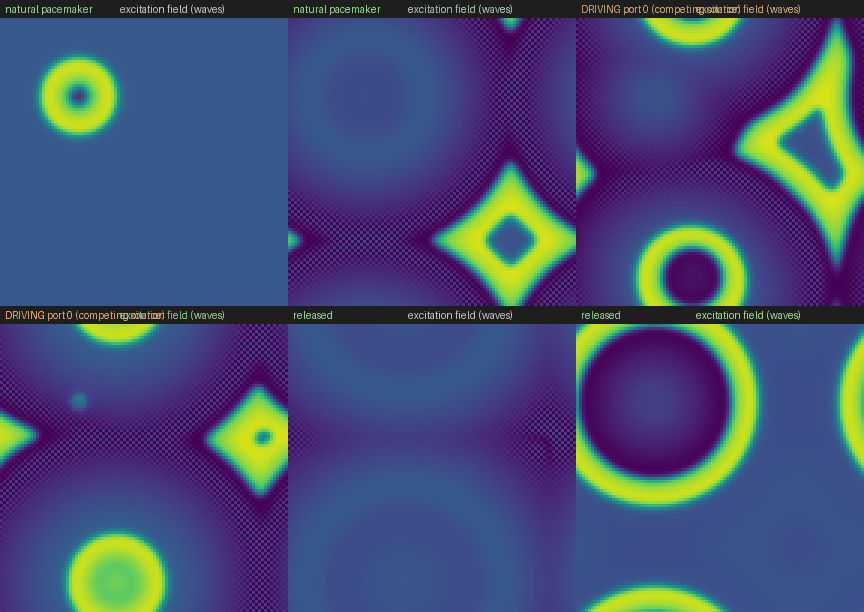
Two fields per cell: food U and substance V. Food drips in at a feed rate; V consumes food autocatalytically and decays at a kill rate. Out of three processes come self-sustaining localized objects: a spot of V is a little metabolism eating the food that diffuses in, its own depletion halo capping its size and repelling neighbours. The objects persist, starve if feed is suppressed, split if it is raised — none of it programmed. Higher worlds add apparatus ports that secretly move or toggle sensors (instruments to discover: a field port acts like a force, an apparatus port like a stage), drift (objects wander; sensors see transit traffic), a second species with a host–tenant dependency and cascade extinctions (C3), and finally an excitable wave medium (C4): a hidden pacemaker emits travelling rings; drive a port steadily and you create a competing pacemaker; drive too fast and the refractory period blocks conduction. C4's compact timing laws fit on an index card and currently defeat every frontier model.
Chemistry track opens: a two-substance reaction world where the stable structures are LOCALIZED OBJECTS (self-sustaining spots), not system-wide switches. Ports perturb the local feed rate: the right drive can starve an object to death or fatten it. Sensors are fixed; half sit near objects, half watch empty background.

Chemistry + microscopy: bigger world, and SOME input ports secretly move a sensor (a translation stage) or toggle one, instead of touching the world. Stage ports integrate (effects persist after release and reverse under opposite drive) — discovering which ports are apparatus is part of the science. Scanning a movable sensor across the world is how you find distant objects. One preparation contract is answerable ONLY by operating the stage.


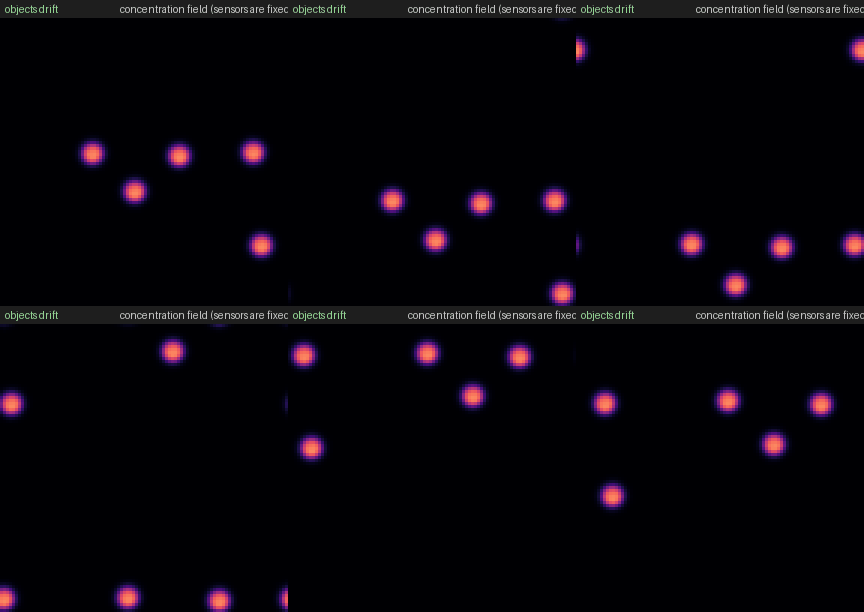
Moving chemistry: the objects DRIFT (~1 cell / 20 ticks along a hidden direction), so every sensor sees transit traffic rather than a fixed scene. Tail averages converge to traffic statistics; half the prediction contracts ask for a channel's fluctuation level (sd) — understanding requires modeling motion, not just levels. Includes apparatus ports and occasional object births/deaths. No preparation contracts in v1: positions are transient by design (tracking preps are future work).


MULTI-SPECIES chemistry (two coupled reaction systems). Two kinds of object exist: species A is self-sufficient; species B can only survive in A's presence — B objects live stacked ON their A hosts, and killing a host kills its tenant (a cascade law). Each input port feeds ONE species (hidden tag); each sensor reads a hidden species mixture. That there are two kinds of stuff at all is itself a discovery: agents must separate the species from port responses and sensor correlations before the dependency and cascade laws even become visible.


EXCITABLE chemistry: the medium carries traveling WAVES. A hidden pacemaker emits rings of excitation; every sensor reads a periodic pulse train (phase = distance / wave speed). The compact laws: a wave speed, a refractory period (drive too fast → skipped beats, 2:1 block), and ENTRAINMENT (any faster rhythm source — including one the agent creates with a sustained port drive — takes over the whole medium; on collision the faster wave annihilates the slower). Contracts ask for pulse RATES and mean levels under held-out drive schedules: level-thinking fails completely here (persistence theory scores 0.25). Rich, not big: a ~40-line wave theory solves it; nothing less structural does.