Post 6 — from the first cargo hauler to composed logistics lines, and the stability laws machine engineering keeps running into.
The relay tug
Uses the trains of post 4; the landscape-growing counterpart is post 5; the search that found the v3 parts is post 7.
Framing per the ratchet literature (Reimann Phys. Rep.361:57):
a static asymmetric potential cannot transport a passive overdamped particle — and ours
doesn't. This is an active-particle ratchet: the blobs' own drift mode is the
motor, the sawtooth only rectifies it (cf. bacterial ratchet gears, Di Leonardo et al.
PNAS107:9541). Our earlier noise-ratchet negative matches soliton-ratchet
theory exactly (Salerno & Quintero PRE65:025602: transport needs a
soft internal mode or translational noise — our solitons are too stiff).
A machine needs an opponent: a load field the cargo will not climb by itself.
The trick that makes this clean is zero-footprint forcing ("isok" mode): shift
(k₁, k₄) together along the iso-background line as a static function of position,
b(x). The vacuum state stays an exact fixed point everywhere (checked to 1e−16) —
the landscape is invisible until a blob shows up, and then it feels a force pushing it
"downhill" toward lower b. A sawtooth b(x) (5 teeth, period 32, gentle rise + sharp cliff)
makes a periodic track where downstream = down the long rising ramps.
Field-theory view of isok (for readers who like actions). To be precise about the
knobs: isok shifts both couplings together, k₁ → k₁ + u₀·b(x) and k₄ → k₄ + b(x)
(not k₄ alone) — the direction in (k₁,k₄) space along which the vacuum root u₀ is exactly
preserved, because the vacuum condition −u³+(λ−k₃−k₄)u+k₁=0 traces a straight line of
slope u₀ in that plane. The perturbation to the u-equation collapses to a single term:
δ(∂u/∂t) = −b(x)·(w − u₀)
which is identically zero on the vacuum (w=u₀ there) — that is the whole zero-footprint
property, now as one line of algebra. And this term is exactly what a trilinear vertex
would produce: add Sint = ∫ b·u·(w−u₀) to a (pseudo-)action and vary in u, and
you get −b·(w−u₀) in the equation of motion. So b is best read not as "changing the
laws" but as a static third field mediating the u–w interaction — a b·u·w coupling
with the u₀ counterterm subtracting its vacuum expectation. Where b≠0, a blob's own
inhibitor shadow (w−u₀ > 0 inside the blob, rippling in the tails) costs energy that
depends on position; the gradient of that cost is the force. Two honest caveats: this
system has no true action (it is dissipative, gradient-flow-like only in pieces), so
"vertex" is an analogy at the equations-of-motion level; and b here is frozen
(non-dynamical) by design — promoting it to a slow dynamical field with its own relaxation
is precisely the door to blobs that reshape their own landscape (chemotaxis-style
self-interaction), which we have deliberately kept closed in machine v1 to preserve
the honesty rule that the environment is static.
The machine, assembled entirely from certified parts:
part
made of
function
locomotive
3-blob wake-locked train (M4), τ=5.70
self-propulsion c≈0.06–0.09, strong enough to climb (a pair is NOT: it reverses on any tested tooth — measured, hence 3 blobs minimum, climb margin 1.53×)
track
isok sawtooth b(x), ε=5·10⁻⁴
the adversary: every parked blob slides downstream into a trough and stays
parking brake
pair-only zone (M4)
lone cargo cannot move itself — it waits exactly where it parked
rails
static y-channel: bchan(y)=0.002·min(|y−y₀|, 24)
a shallow zero-footprint valley in the cross direction keeping the train on axis (without rails the growing train buckles into the trough valley after 1–2 pickups — the certified failure of machine v1)
coupler
M2/M4 wake shells
head-on pickup: cargo locks into the leader's front shell at 14.9 px and becomes the new leader — a pusher-tug; train speed grows per pickup (0.059 → 0.073 → 0.085)
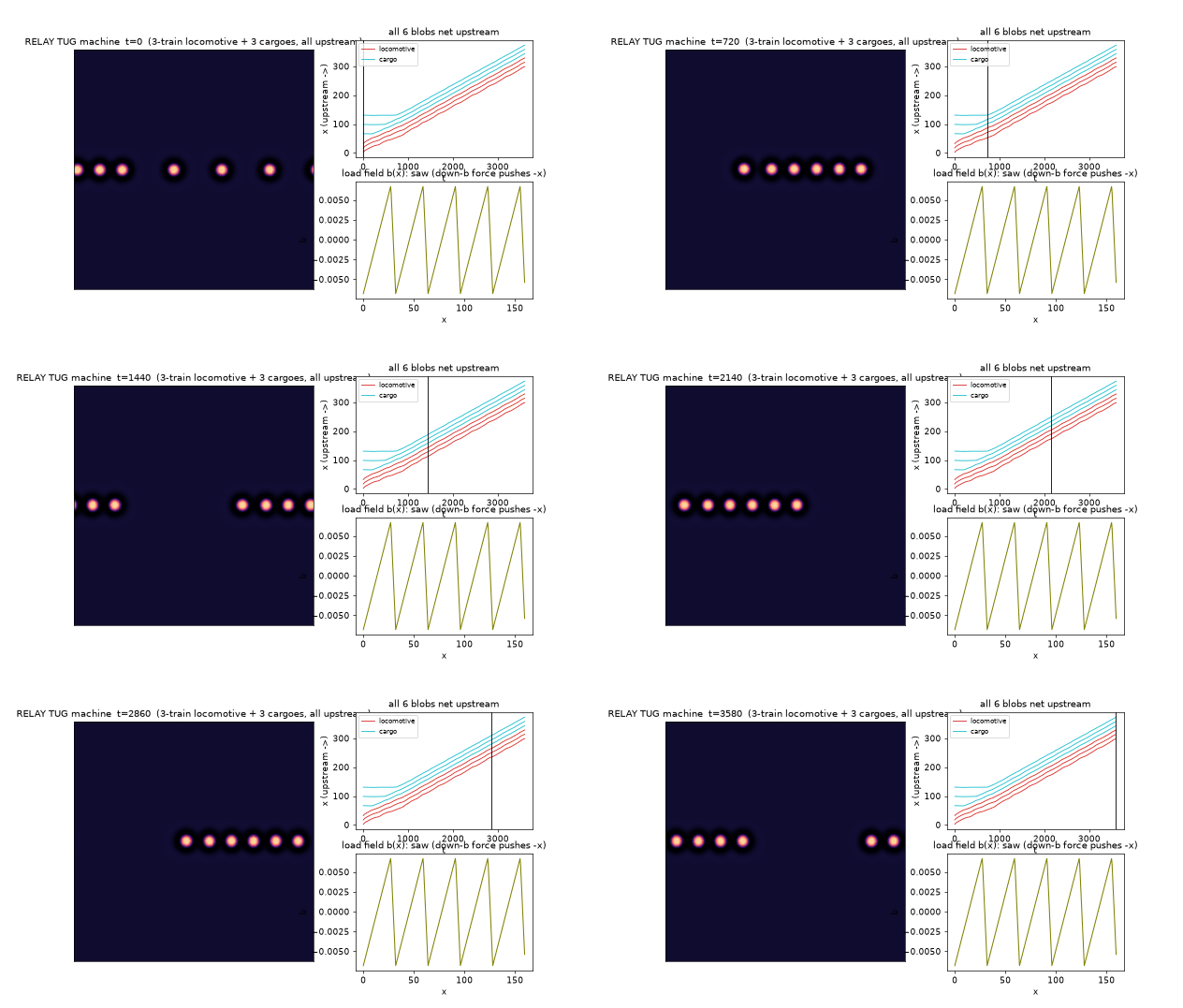
M5 — RELAY TUG, the certified run. Left: the field (bright = blobs).
Right top: all six blob tracks; cargo lines (cyan) sit flat — parked — until the train
arrives, then join the common upstream slope. Right bottom: the sawtooth load field.
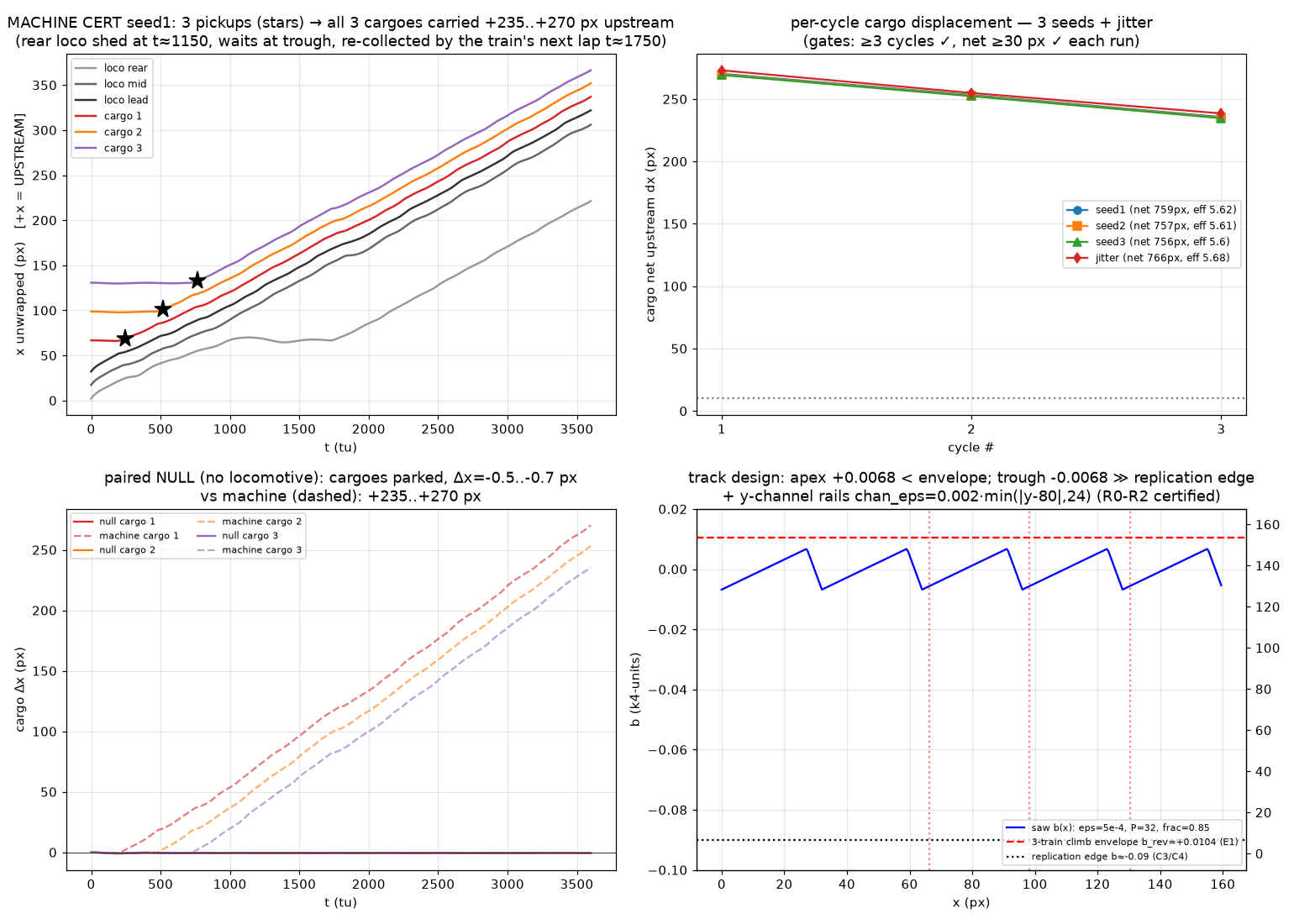
Certification: 3 seeds — 3/3 pickups each, net upstream cargo displacement 757–780 px
(gate: 30), efficiency 5.6–5.8× the do-nothing baseline; null run (no locomotive):
cargo drifts 0.5 px downstream. Fresh-seed controller audit reproduced everything;
blob count stayed exactly 6 for the full 3600 tu.
The certified tug layout (parameters)
component
value
why
world
A=4 family (M0 + Dv=4/τ), τ=5.70
pair-only zone: cargo parks, trains travel
track
isok sawtooth, 5 teeth, period 32, ε=5·10⁻⁴, rise fraction 0.85
Tug certification, four panels.Top-left: every blob's position vs
time in the certified run — stars mark the three pickups; note the rear locomotive
blob shedding at t≈1150 (gray line goes flat = parked at a trough) and being
re-collected on the train's next lap at t≈1750 — the self-healing relay. Top-right:
the gate metrics across 3 seeds + jitter: per-cycle cargo displacement, all runs
essentially identical (net 756–766 px, efficiency 5.6×). Bottom-left: the paired
null — without the locomotive, the same cargoes move −0.5 px (solid lines at zero);
with it, +235–270 px each (dashed). Bottom-right: the track design that makes it
work: tooth apex (+0.0068) below the 3-train climb envelope (dashed red, +0.0104),
trough depth far above the replication edge (dotted, −0.09).
Two emergent bonuses, neither designed: at the 6-train power ceiling the machine
sheds its rear blob, which slides back, parks at a trough (pair-only zone again),
and is re-collected on the next lap — a self-healing relay. And because pickup
happens by wake capture, the machine needs no controller at all after t=0: one initial
kick, then pure autonomous physics for as long as we watched.
The factory parts list: tow, dock, fork
Third campaign, 2026-02-20/21: two top-down searchers (blob-factory:
compose certified mechanisms toward the "fulfillment center" vision; blob-genesis:
which hand-built landscapes can the physics grow on its own?) plus the bottom-up
equation-space search (section 12). All audited on fresh seeds as usual. Probe dirs:
probes/blobs/factory/ (112 records), probes/blobs/genesis/ (58).
The factory searcher added one legalism with big consequences: the cross-species
coupling η can be a static field η(x,y) — it enters the v-equations exactly the
way isok enters u, so the vacuum stays exact and "where blobs can grip each other"
becomes geography. That gives three certified primitives and one composed machine:
primitive
result
the law it produced
tow
a traveling pair carries a cargo blob locked in its wake
well (155 px conveyed at full pair speed)
near-onset cargo law: deep-static
cargo (τ₂=2.5) is untowable — any coupling strong enough to grip it destabilizes
something (the well ceiling is 0.017, below every stable carrier speed; mutual-η carriers
replicate). Cargo parked in the rotor-only zone (τ₂=5.60) still self-parks, but its well
response is 7–8× amplified (near-onset susceptibility — M5's adversary physics
turned into the coupling): it locks at 8.46 and tows at full speed. One dial switches
cargo between inert freight and towable. η=0.1 tows / 0.05 drops.
unload dock
an η→0 null zone (vacuum-exact) releases the towed
cargo: 6.5–7.5 px glide past the edge, then frozen ≤0.3 px/500 tu; carrier continues.
3/3 seeds + carry-control (held 149 px) + null-control (1.15 px)
release needs
no unbinding physics — switch off the grip in space, not in time. The missing
"delivery" primitive from M5, solved by coupling geography.
bonus dial: timescale asymmetry
(M slides at 0.074 px/tu, S at 0.0047) — speed sorting even without species rails.
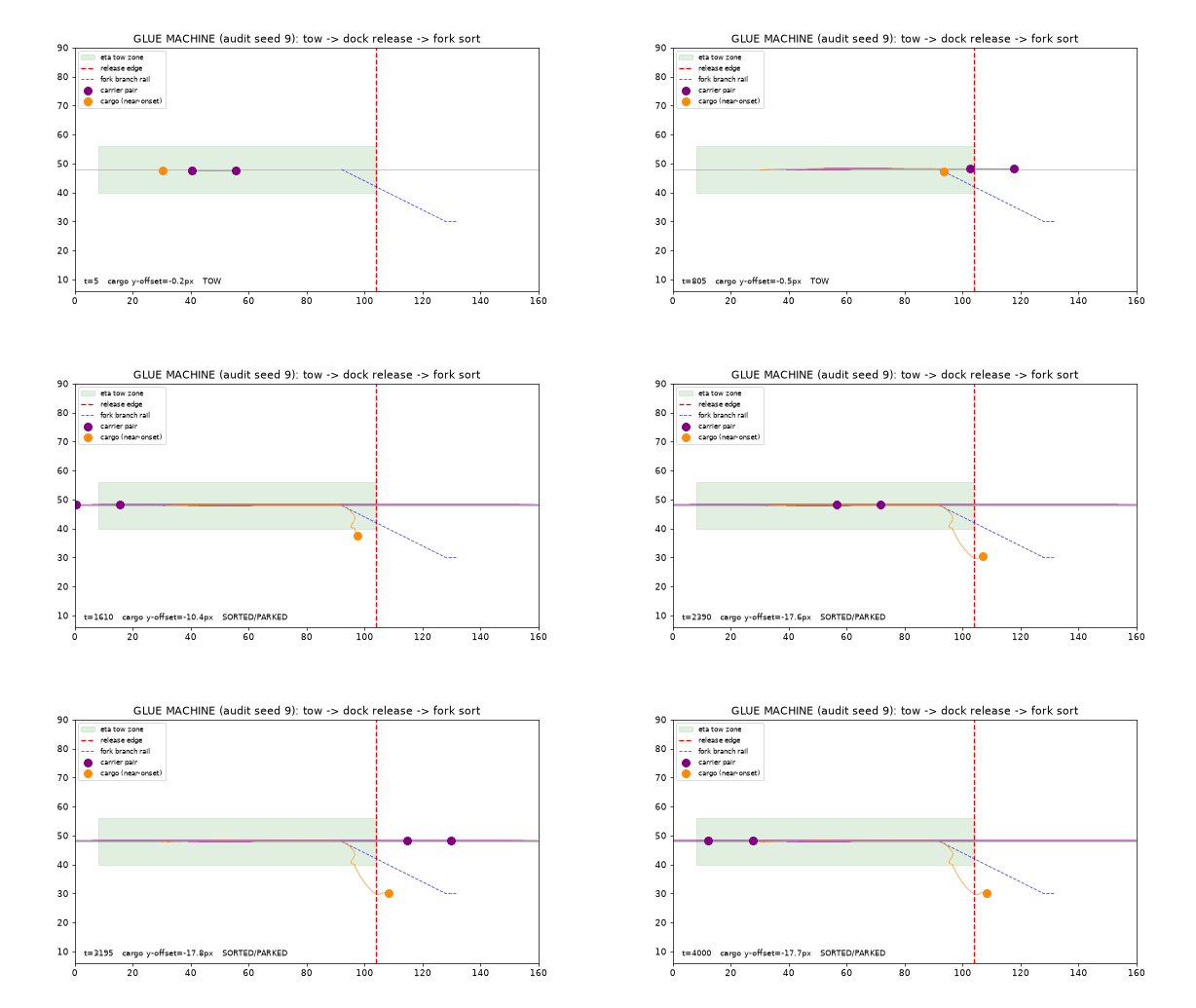
The glued machine, controller-audit run (fresh seed). One world,
three mechanisms chained: the carrier pair (purple) picks up near-onset cargo (orange)
and tows it along the lane through the η-active zone (green); at the release edge
(red dashed, x=104) the grip vanishes and the cargo glides free; the fork branch rail
(blue dashed) catches it and sorts it to a parking spot 17.6 px off-lane; the carriers
keep lapping (net +293 px). Blob count constant throughout — no replication, no death.
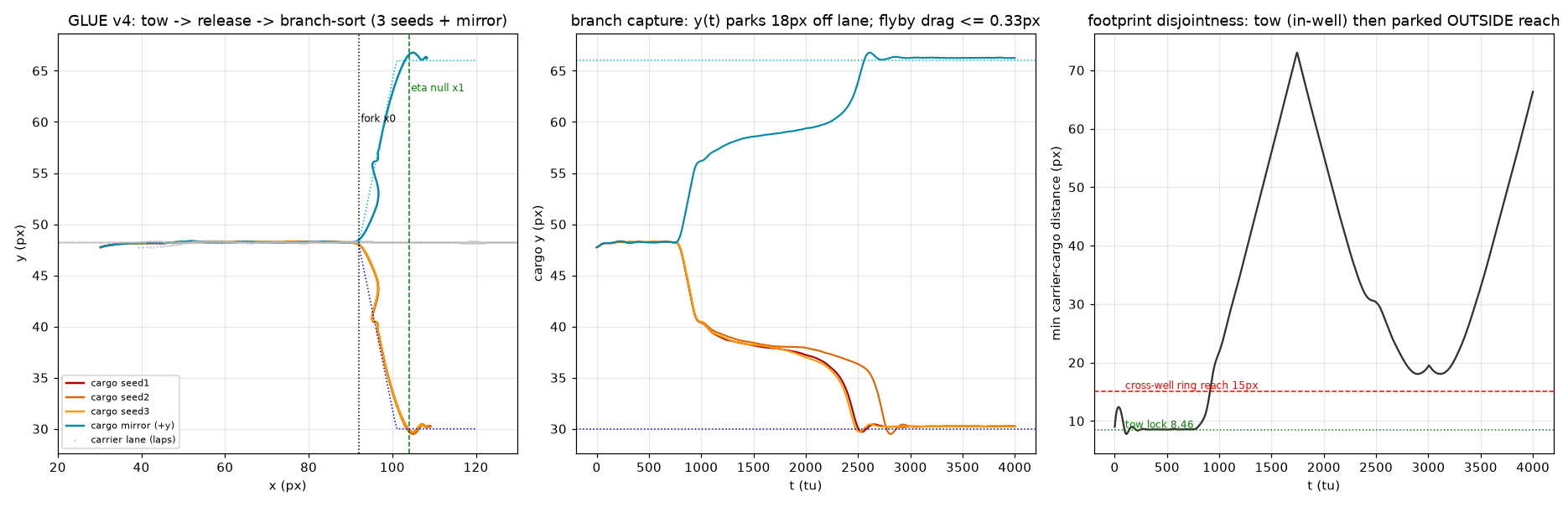
The composition rule (the actual L3→L2 finding). Gluing
mechanisms is not free: v1 parked the cargo 7.4 px from the lane and every carrier
lap dragged it 6.6 px; v2's fix got it re-captured; releasing at the fork crotch
trapped the carrier head-on (4/4 reproducible). The rule that emerged: certified
primitives compose iff their interaction footprints — tow-well reach (15 px), rail
walls, carrier lane — are disjoint at every handoff. Machine design in this physics
is geometric margin management, not new mechanisms. (Also mapped: the "roller" idea —
using a spinning heterodimer to advect grazing cargo — is a positioner
(~0.07 px/rev, certified, sign-locked, null exact) but not a conveyor at safe
couplings; at brief parameters the rotor instead captures the cargo and converts into
a new object, an S–M–S pendulum librator (period ~307 tu) — extending the motion
hierarchy: bond < travel < rotate < librate.)
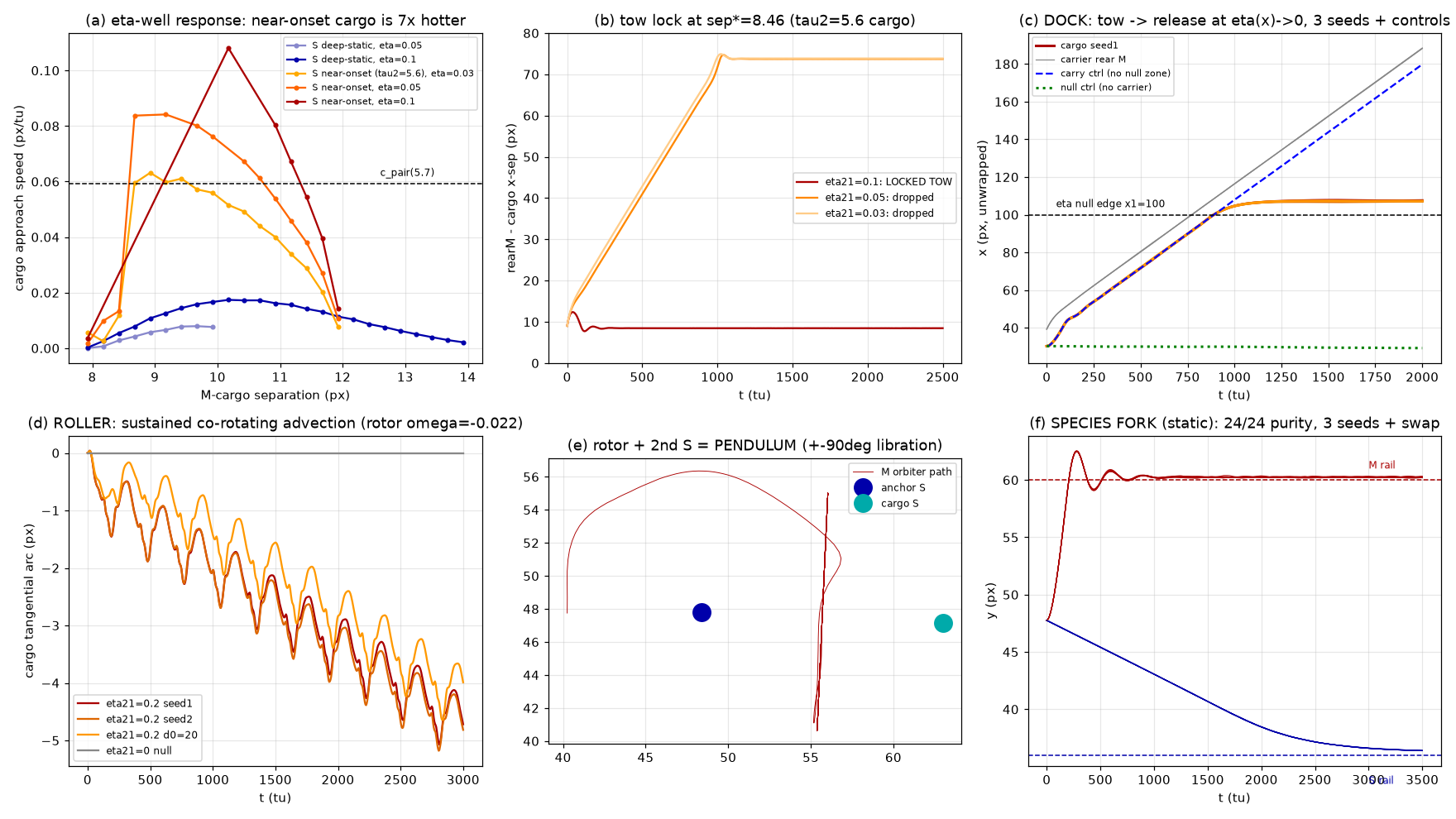
The factory primitives, panel by panel.
(a) the near-onset cargo law: approach speed into a carrier's η-well vs distance —
deep-static cargo (blues) barely responds at any coupling, near-onset cargo (oranges/reds)
responds 7–8× hotter; the dashed line is carrier speed — only near-onset cargo can keep up.
(b) tow lock: carrier–cargo separation vs time — η=0.1 locks at the 8.5px shell and
holds for the whole run; η≤0.05 drops the cargo.
(c) the dock: cargo x(t) riding the carrier (red on gray) until the η-null edge
(dashed black), then a short glide and a permanent park — while the carry-control
(blue dashed, no null zone) keeps going and the null-control (green dotted, no carrier)
never moves.
(d) the roller verdict: tangential cargo arc next to a spinning rotor — real but
tiny (~5px per 3000tu, exactly zero in the η=0 null): a positioner, not a conveyor.
(e) the pendulum surprise: put a second anchor near a rotor and the orbiter
converts to ±90° libration between them — a new composite mode (bond < travel <
rotate < librate).
(f) the species fork: y(t) of the two species entering the fork — M (red) climbs to
its rail at y=60, S (blue) descends to y=37; 24/24 sorting purity across seeds and a
mirrored-geometry swap.
Machine v2 — the convoy line and the law cascade
Scaling the glue machine from one cargo to a queue of three produced a genuinely
new machine and three new laws that stopped it short of full certification —
the most instructive outcome so far.
The machine that works (certified 3/3 seeds + fresh-seed audit): on a railed
lane, a carrier meeting cargo head-on doesn't swing around it (rails forbid the
factory's swing-around geometry) — at moderate grip the meet becomes a stable
push-capture "blade": the cargo rides 7 px ahead of the carrier at full
speed. So sequential one-at-a-time service is impossible on rails; the only
throughput machine is a bulldozer convoy — the carrier sweeps the whole queue
into a chain and delivers it wholesale. One trick makes the convoy sortable: a
sacrificial plug blob rides the blade slot (which can never be fork-sorted —
its y-hold is weaker than the fork needs, with 4 distinct trap limit-cycles mapped),
so the chain-pushed real cargoes sort cleanly behind it: all 3 delivered to
the branch floor as a bond-shell stack (15.3–15.5 px spacing), blob count frozen,
cycle time 215 tu.
The law cascade that blocked the full gate: the delivered 3-stack is itself
a bonded structure — and per M4 physics, bonded structures near onset travel.
The parked stack shuttles ±9 px (isolation control: intrinsic). Fixing it means
colder cargo (τ₂ < τ_c(3) ∈ (5.55, 5.60]) — but colder cargo compresses the blade
gap below its ~5.4 px split floor at working speed (blade-load law), and
slowing the convoy to protect the blade makes the blade contact transversely
unstable (slow-convoy buckling, the M5 buckling generalized). For a 3-cargo
convoy the window is empty in this architecture. Stack-safety, blade-load, and
buckling are now quantified design laws — machine engineering in this physics is
navigating a lattice of competing stability windows, exactly the kind of hidden-law
structure the eventual agent-facing world wants.
Machine v3 — the first machine built from searched parts
Certified. The carrier is the 3-field engine the atlas found (c=0.20–0.34);
the cargo is the plateau-bond world blind uniform search invented; neither was
designed. The only engineered step was the coupling, and even that was found by
systematic search over coupling moves: the suggested weak cross-v failed (no grip at
0.05, splits the engine at 0.10), single-channel writes failed, and the minimal grip
turned out to be a 60% "phantom cargo" imprint — the engine writes a scaled
copy of the cargo's own field signature into the cargo's channels, one-way, leaving
engine dynamics unchanged to 4 digits. Tow is a push blade at 4.3 px standoff
(pull is impossible — an engine placed ahead simply runs away); drag 131 px per lock
noiselessly (controller-replicated to 5 digits), lock–slip–relock under working noise
(caveat recorded). Release is the cleanest yet: cut the coupling and the cargo parks
instantly (10⁻¹⁵ px), and a decoupled engine laps the torus straight through
the cargo's neighborhood without disturbing it — architectural flyby immunity.
Delivery mode has a twist the laws demanded: towing a pre-bonded 3-stack is a
mapped no-go in this world (full-speed pushing merges the chain; slow pushing tears
it). The certified machine instead does sequential single-cargo pushes with
assembly at the dock: three noisy-seed runs each delivered a parked, bonded
3-stack at the certified bond spacing (13.6–14.0 px) with hold drift under 0.002 px —
the stack-safety property the plateau cargo was recruited for, demonstrated in the
delivered product.
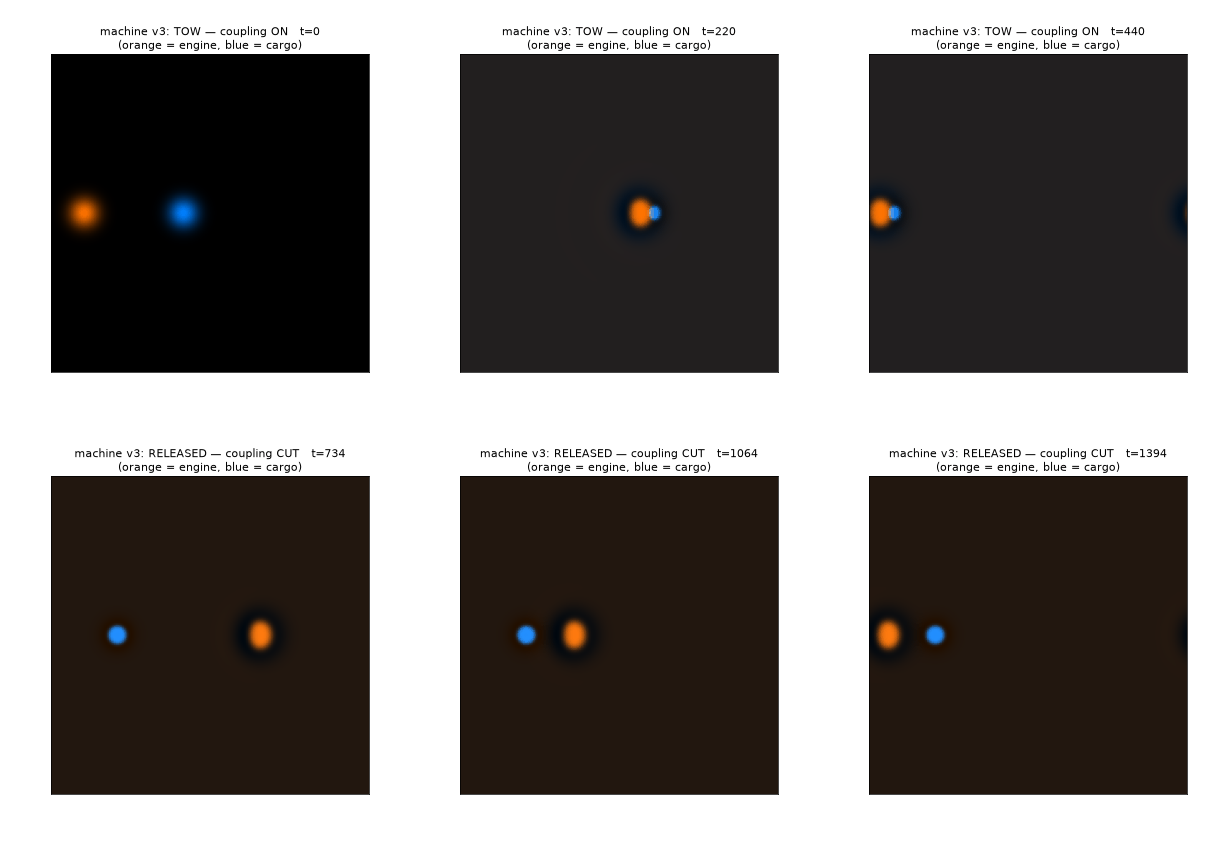
Watch tow-and-release (both species' activator fields; orange = engine, blue = cargo): with the phantom-cargo coupling ON, the engine closes in and
push-blades the cargo across the domain at 4.3 px standoff; at t=500 the coupling is
CUT — the cargo freezes on the spot (drift 10⁻¹⁵ px) while the engine, now blind to
it, drives on and laps the torus straight past the parked cargo without a nudge:
release and flyby immunity are the same property, seen from two sides.
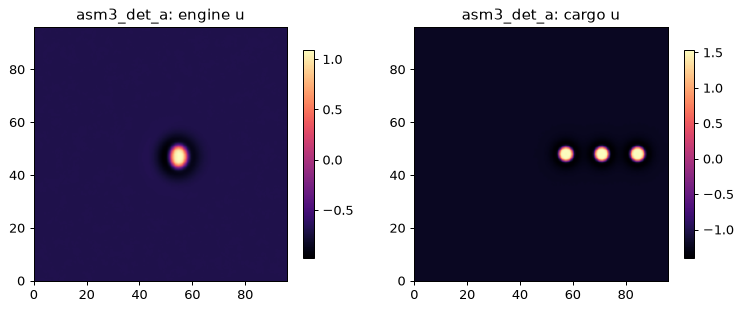
The delivered product (final field of an assembly run,
cargo species): three sequentially-delivered cargoes parked as a bonded 3-stack at the
certified 14 px plateau-bond spacing. This stack does NOT shuttle — the plateau bond's
stack-safety property (post 7, finding 2), demonstrated in the machine's output.
Earlier status note
The convoy line's three blocking laws (stack-safety, blade-load, buckling) were turned
into search queries, and the equation-space atlas answered all three — see
post 7 for the harvest. The v3 parts list:
a 3-field engine carrier at c = 0.20–0.30 (2–5× blade-load margin), plateau-bonded cargo
stacks that park motionless under noise (the stack-safety fix), and two candidate
3-species worlds with clean cross-bonds for species-tagged rails. Separately, a
closed-loop recirculation test (cargo gripped → towed → released → re-gripped over
multiple carrier laps) and the first machine with an L1-grown component are in
progress. This section will be updated when v3 certifies.
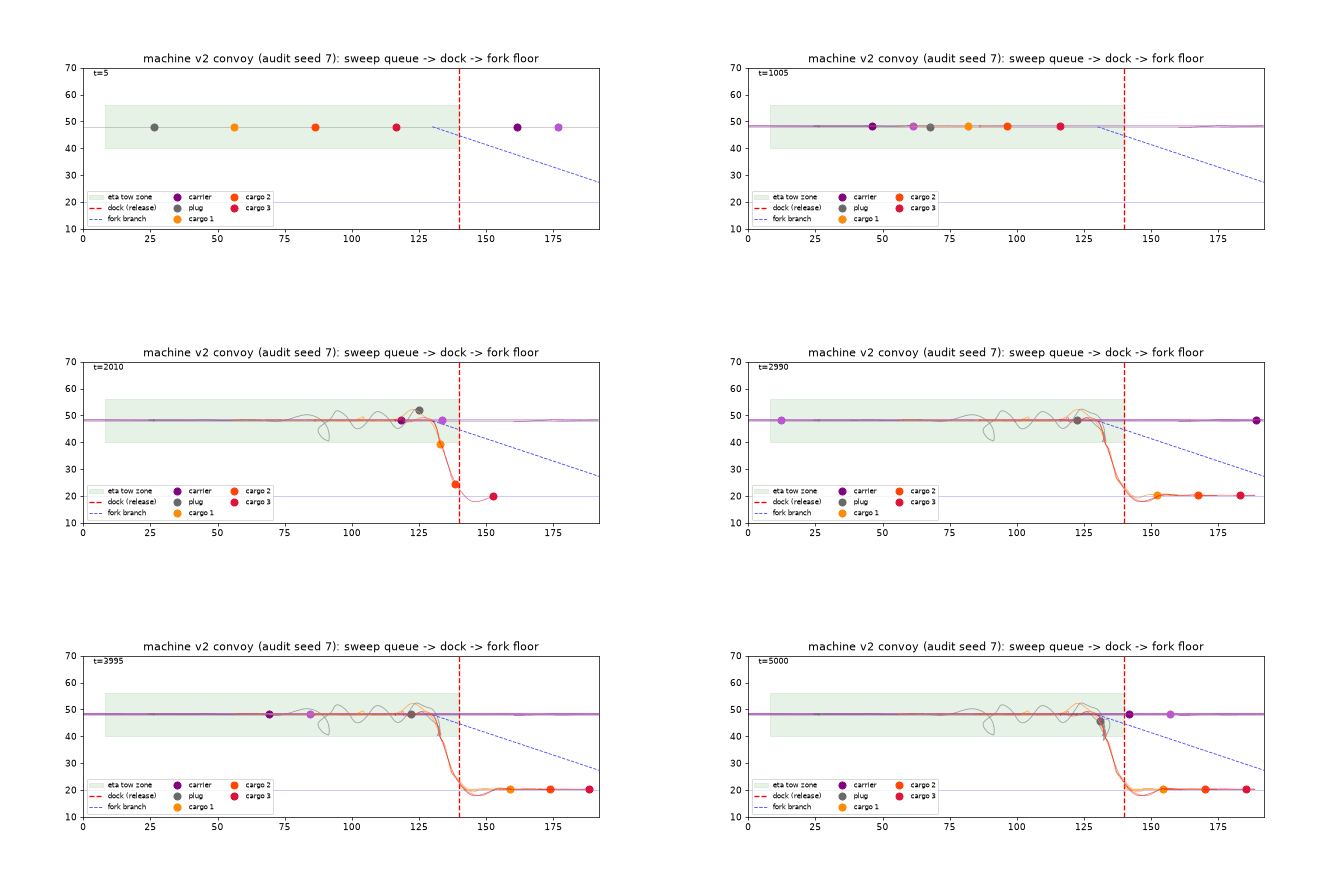
Watch the convoy run (controller-audit seed): the carrier pair
(purple) sweeps up the plug (gray) and three cargoes (oranges) into a blade convoy
inside the green coupling zone; at the dock (red dashed) the chain releases; the three
real cargoes slide down the fork branch (blue dashed) to the y=20 floor and park as a
bonded stack, while the plug stays on-lane — it can never be sorted, which is exactly
why it rides the blade slot. The wiggle near x≈120 is convoy formation: the blade
finding its standoff.
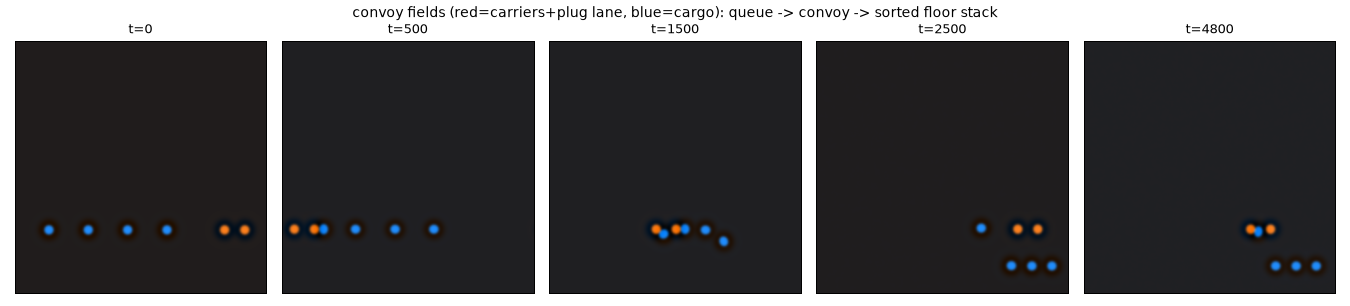
The same run in the fields (red = carrier species, blue = cargo
species): queue on the lane → convoy → sorted floor stack.
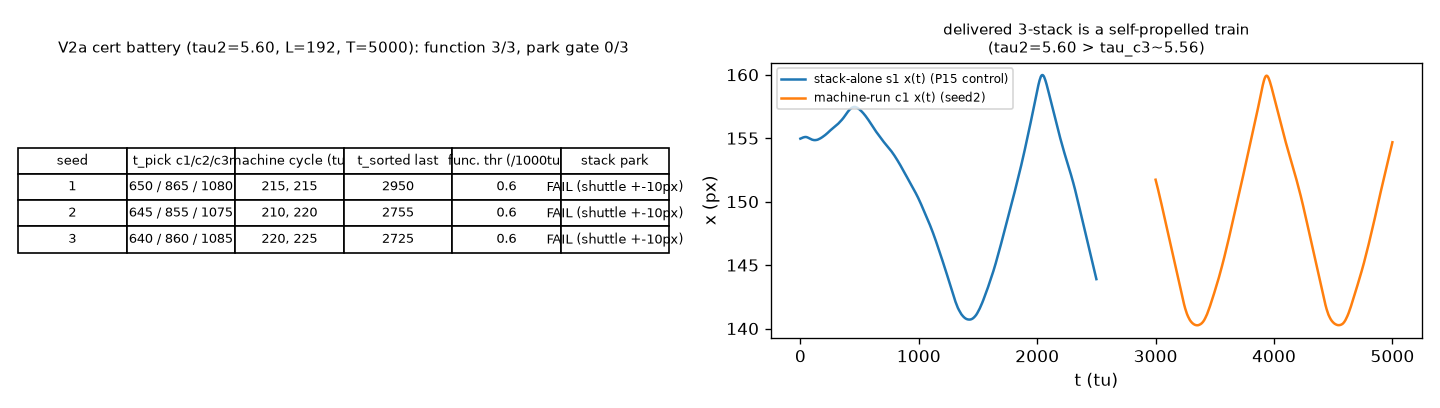
Why full certification failed — the delivered stack is alive.Left: the cert table: function passes 3/3 seeds (pickups, sort, throughput) but the
park gate fails 3/3 — the delivered stack shuttles ±10px. Right: the smoking gun:
x(t) of a delivered-stack blob (orange) vs the same stack built in isolation (blue) —
both oscillate identically. The stack is not being disturbed; it is a bonded 3-train at
τ₂=5.60 > τ_c(3)≈5.56, and bonded trains above threshold travel. The fix (colder
cargo) is blocked by the blade-load split floor, and slowing down hits buckling —
the three-law cascade in the text.
The recirculation no-go (V2c, closed)
Can a single dock recycle its own cargo — grip, tow, release, and re-grip on the
next lap? Two certified runs answer no, structurally: the cargo is towed once,
released past the coupling-zone edge, and parks outside the zone — where the
lapping carrier passes it 4+ times with zero re-grip and zero disturbance (the same
flyby immunity that makes release clean makes re-collection impossible). The law:
release and re-entry cannot share an edge — closing a loop requires a return
leg (a second zone with an opposing carrier, or a landscape slope sliding parked
cargo back to the entry — the genesis toolkit's job). Docks compose in series only
with an interposed transport primitive. This closes V2c as a mapped negative and
writes the requirements list for a true closed-loop logistics line.
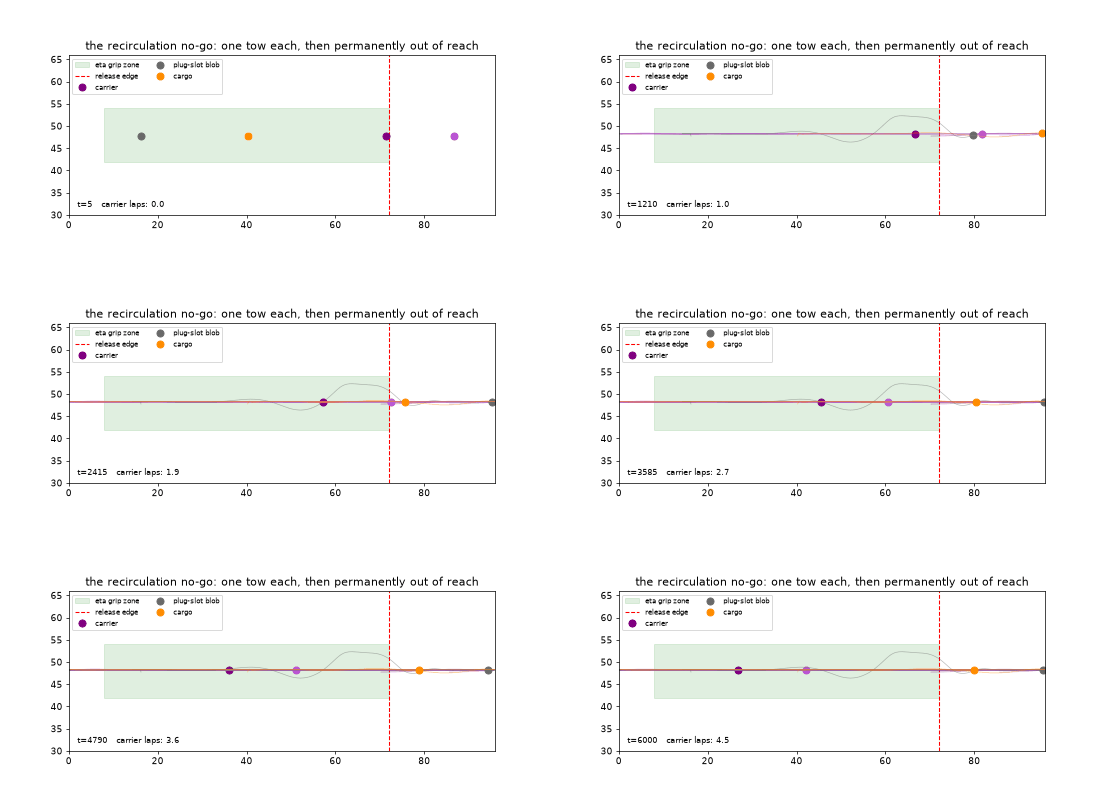
Watch the no-go: the carrier (purple) grips each towable blob
once inside the green zone, releases it past the red edge — and then laps the torus
again and again (counter top-left), passing within pixels of the parked cargo with
zero re-grip: outside the coupling zone, the cargo is invisible to it. The release
property and the un-collectable property are the same physics. Closing a loop needs
a return leg.