Post 7 — the bottom-up track: instead of designing worlds, sample the space
of field theories and let physics tell us what exists. 4,500+ candidate universes screened
for ~$12 of compute; every headline independently re-verified.
What the search found (the seven results)
#
finding
status
1
A second binding mechanism — the "plateau bond": worlds with NO
oscillatory tails that still bind at quantized distances, via a saturating (tanh) channel.
Invisible to our shell theory by construction; found twice independently by blind
uniform sampling. 41-cell family; d* tunable 14–30 px by one dial.
audited ✓ (ablations + fresh-seed bonds)
2
Plateau stacks solve the machine program's cargo problem — 3-stacks
of plateau-bonded blobs park motionless under noise, where the classic M4-bond stacks
self-propel (the machine-v2 blocker). The stack-safety fix came from the atlas, not from
design.
audited ✓ (head-to-head with M4 control)
3
A second motility mechanism — a standalone 3-field "engine"
(A=τ·Dv≈2.5, far from the drift-onset family) traveling at c = 0.20–0.34:
2–2.4× faster than anything hand-designed, robust ±10% on every dial. Found as a slaved
component inside a search hit, then purified by decomposition.
audited ✓ (records reproduced to 4 digits)
4
Motility is rare and lives in exactly two mechanisms. Census of all
996 alive worlds: 2.4% travel. By ancestry: dynamical-b lines 16% (stigmergic self-launch),
engine/rotor lines ~4% (two-timescale engines), the classic M0/M4/VVW families
0% in 321 worlds. Two independent protocols agree to 0.3%.
census complete
5
Recombination beats mutation, structurally. Merge operators
(validated by reconstructing our own vvw and xv design jumps) found ALL multi-species and
ALL cross-species physics cells; plain mutation was worse than dumb jitter. The evolver
also rediscovered the rotor from parts without the recipe.
audited ✓ (rotor ω to 4 digits)
6
An unplanned ecology primitive: predation. One searched 3-species
world has a conserved kill interaction (species 1 eliminates species 2 on contact, at all
distances) plus an apex self-bond. Parked for the world-catalog phase.
observed (6/6 assays), not yet audited
Everything below explains how these were found and gives the evidence.
How: the levels doctrine (why a bottom-up track exists)
The certified physics this searches over: posts 1–6. The G0c funnel derives from the spatial-eigenvalue analysis introduced in post 3.
Phase 2 clarified the working structure of blob science as a ladder of description
levels:
level
what is given
what you study
example
L1 — field level
only the PDEs and initial conditions; every
field (including b) dynamical
what landscapes/structures the physics builds
on its own
M6: trails, self-launch, b-assembly, the standing sawtooth
L2 — background level
a hand-written static b landscape
what dynamics the landscape can host
M5 machine: saw track + rails;
RT3 ring valleys
L3 — molecule level
bonds/rotors/trains taken as certified
components
what circuits and machines the components compose into
relay tug; rotor-based devices (future)
The doctrine: findings at a higher level must be reducible to the level below by a
learned process — L2 landscapes should be reachable as L1 fixed points (the inverse
problem: can deposition + relaxation evolve b into the sawtooth-and-rails the machine
needs? the phase-2 teaser says the sawtooth, at least, is a natural attractor), and L3
components must carry their L2/L1 certificates (bond curves, dial laws, stability
windows). Higher levels buy speed of exploration; reduction buys legitimacy — a machine
sketched at L3 is a conjecture until its landscape is demonstrated at L2 and, ultimately,
grown at L1. The two phase-2 tracks are therefore not merged but stacked: L2 work
discovers what is worth wanting; L1 work discovers what can be grown; the reduction map
between them is itself a research object.
The bottom-up search (L0), status. The genome/funnel/assay stack is built
and certified (reproduces every reference world to 5 digits; the spatial-eigenvalue
screen predicts bond shells of unseen worlds to ~±15%). Stage-1 yield curves: uniform
random finds ~2 alive worlds/100 candidates (but both novel mechanisms so far —
including a bond with no oscillatory tails, a second binding mechanism our theory
did not predict — came from uniform); jitter around references finds ~49/100 (maps
island geography 25× faster). An evolutionary layer (merge = block composition,
validated by reconstructing our own vvw and xv design jumps as single merge operations)
beats jitter on alive-cells per assay and owns ALL multi-species coexistence cells —
it even rediscovered the rotor from M4 parts without the recipe (audited: ω to 4
digits). The 32-worker pod sweep (3,195 candidates, ~$9 of compute) came back: the archive
grew 111 → 404 cells. Confirmed at scale: jitter yields 51% alive / 24% bonded;
blind-uniform novelty is ~1/600; the bond-shell law settled at d\* = (1.37±0.13 +
0.55k)·wavelength over 830 bonds. New physics found by the sweep: the
non-oscillatory "plateau bond" is a robust 41-cell family (a saturating-inhibitor
well, invisible to the tail eigenvalues by construction — binding chemistry beyond
the funnel's prediction), plus at least one further unattributed binding route; the
first 3-species bonded matter (from the evolver's elite line); 13 self-launching
worlds; and a program speed record — c = 0.204, a jittered descendant of the
evolver's rediscovered rotor, 45% faster than anything hand-designed
(controller-audited to 4 digits). Every candidate carries its selection provenance
(anthropic-screening doctrine).
How: the genome and the algebraic funnel
Every world in the search is a point in one canonical family — n cubic activators
coupled to m linear-or-saturating channels:
The genome is {acts: (λ, k₁, D_u)ᵢ, chans: (τ, D, g)_c, W, K} — and because every
channel is driven by deviations (u−u₀), the uniform vacuum is an exact fixed
point for any weights: the iso-line trick as architecture. All five hand-built worlds
(M0, the motility line, vvw, xv, bfield) are reference points of this family,
reproduced to 5 digits by the generic simulator before any sampling was allowed.
Candidates pass a microsecond-scale algebraic funnel before any simulation:
G0a max_k Re eig(J − k²D) < 0 (vacuum temporally stable — else Turing soup)
G0b −u³+λu+k₁ has 3 real roots (local bistability — an "on" branch exists)
G0c spatial modes e^{μx} of the steady state: D_u s + a − Σ_c K_cW_c/(1−A_c s) = 0, s=μ², A_c=τ_c D_c
complex μ ⇒ oscillatory tails ⇒ bond shells at d* = (1.37±0.13 + 0.55k)·2π/|Im μ|
G0c's shell prediction was validated on the certified worlds (10.9px measured vs
10.8 predicted) and then held across 830 bonds of the stage-2 sweep. Blob existence
itself is subcritical (a homoclinic orbit — no local criterion suffices), so one
seeded poke per candidate settles it; the funnel just makes the poke affordable.
Evidence I — yields and costs (findings 4, 5)
strategy
alive /100
bond /100
role
uniform random
0.5–2
~1
mechanism discovery (both new binding mechanisms came from here)
jitter around references
49–51
14–24
island mapping (25× cheaper per alive world)
evolver merge
7.7 cells/100 assays
—
composition: ALL multi-species and cross-species cells
evolver elite line (e1_9508)
89.8
41.8
evolved genomes are robust genomes
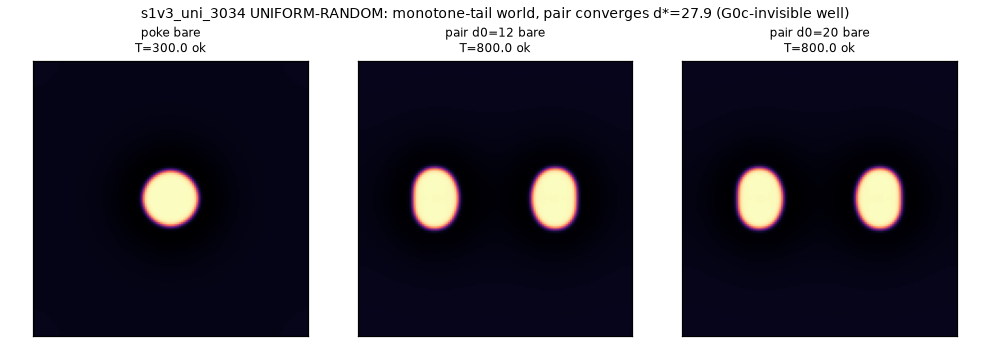
Finding 1's first specimen: uni_3034 — binding without oscillatory tails. The monotone-tail world that bonds anyway (d*=27.9, two-sided): the plateau-bond mechanism, invisible to G0c by construction (its tanh channel has g′(0)=0). Blind uniform search found what the theory could not predict.
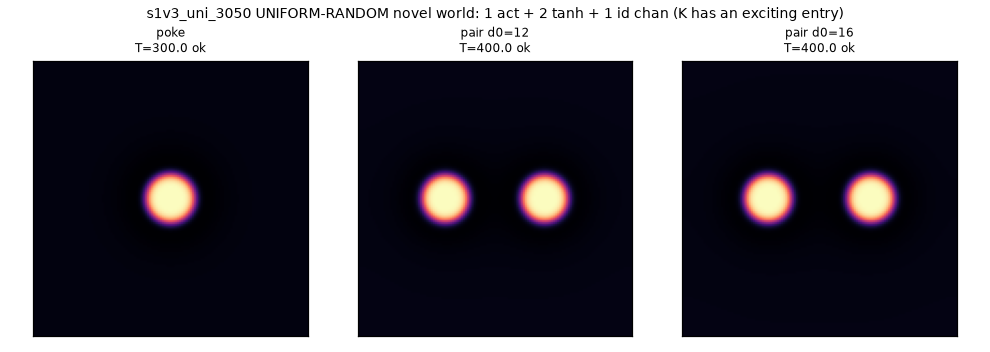
The other uniform novelty (uni_3050): a tanh-channel core with an exciting K entry; merge-or-repel pair law.
Evidence II — the stage-3 harvest (findings 2, 3, 4, 6)
17 shards, 1,068 records, 4 pods, ~$3. Everything below controller-verified
on fresh reruns where marked.
The carrier census (findings 3 & 4)
Of 996 alive worlds given the kicked travel assay, only 24 travel (2.4%) —
self-propulsion is a scarce phenotype in equation space, exactly as the funnel's
near-onset analysis predicted. And it is not uniformly scattered: the traveler rate by
ancestry is 16% for dynamical-b lines (self-launchers — motility by deposition
is the easiest route), 4% for the engine/rotor lines, ~2% for uniform ancestry,
and 0% for the M0/M4 and VVW lines (170 and 151 worlds each, not one traveler —
the classic families are deeply static away from their tuned onsets). Speed
leaderboard: c = 0.304 (XV-line jitter, verified independently to 4 digits ✓),
0.245, 0.208 (both from the evolver's slow-tanh merge line e1_9513), 0.204 (the
3-field engine) — and combining the engine's two best dials (Du×1.1, D_v×0.9) gives
the outright program record, c = 0.3439 in a bare 3-field world (verified ✓).
For scale: the best hand-designed carrier was 0.143. The two independent motility
protocols (census kicks; dial-ladder onsets) agree on the overall rate to within
0.3% — and on the deeper point that all known motility lives in exactly two
mechanisms: stigmergic self-launch and two-timescale v/w engines.
The encounter tables (finding 6 + machine parts)
Six 3-species worlds got full pairwise encounter matrices (three cross-pairs ×
three distances). Two are machine-grade: s2_111_17 (two distinct
cross-species bonds, zero replication anywhere — the species-rail candidate) and
s2_116_46 (cross-bond in a robust cell). Two replicate on contact
(fragile lines), one is inert. And one — s2_101_58 — shows
kill outcomes: one species consistently eliminates another on close encounter
while surviving itself. That is a predation-like interaction, found by blind search,
not designed. It is parked for the world-catalog phase (a predator–prey blob ecology
is now demonstrably available in this equation space).
The stack verdict (finding 2)
Head-to-head stack probes: plateau-bonded stacks (the tanh-well binding family)
park motionless at n=2 and n=3, including under working noise, while the M4
control stack shuttles under noise exactly as machine-v2's law cascade predicted.
The stack-safety problem is solved by a binding mechanism that blind uniform search
found and that our tail-eigenvalue theory is structurally blind to. (Update — the census closed this: the uni_3034 "death" was a job-spec artifact
(dressing overdose); re-run bare, its 3-stack parks at 29.3 px under noise,
controller-verified. Both family members are usable cargo, and the plateau design
rule gives a d\* menu: 14 px fixed, or 20–30 px tunable via the slow-channel τ —
stack spacing fully decoupled from tail physics.)
Machine v3's parts list, assembled by search
need (from machine-v2's law cascade)
answer (from the atlas)
faster carrier (blade-load margin)
3-field engine family, c = 0.20–0.30 (2–5× margin)
cargo that parks (stack-safety)
plateau-bonded stacks (noise-parked at n=3)
species-tagged rails (two-way sort)
s2_111_17 / s2_116_46 cross-bond worlds
This closes the loop the program was built to test: top-down machine
failures became bottom-up search queries, and the search answered all three. The next
machine will be built from parts no one designed.
Next: machine v2 (multi-cargo delivery-and-sort logistics from the
certified parts), the b_target inverse problem (differentiable-RD or evolutionary,
now that the forward map is characterized), pod-harvest atlas review, then
world-ification — anonymous ports, alienization, prediction/preparation contracts
(bond lengths, speed laws, climb thresholds, delivery tasks), certification, oracle
and frontier baselines. The blob universe joins the catalog when it passes the same
gates as every other world.